Quick verdict
You do not need the newest walkthrough format. You need the format that helps buyers trust the space faster, understand the next step, and feel confident enough to contact your team.
Gaussian splatting virtual tours are best when a project needs spatial depth, free movement, and a premium sense of presence. Standard 360 virtual tours are still better when the project needs reliable guided navigation, easy website publishing, clear hotspots, mobile-friendly delivery, and a proven business funnel.
For most real estate listings, venue previews, and business websites, a well-planned 360 tour is the safer first choice. For premium properties, museums, heritage spaces, product showrooms, and experimental campaigns, Gaussian splatting can add a more three-dimensional feeling that normal panoramas cannot fully provide.
The strongest answer is often hybrid: use a 360 tour as the dependable website layer, then add selected Gaussian splat scenes where depth, movement, and emotional impact matter most.
Do not choose the capture format before choosing the buyer moment.
The right format depends on what the viewer must understand: layout, room flow, scale, atmosphere, product detail, historical context, or a premium spatial experience.
What is Gaussian splatting?
3D Gaussian splatting is a scene-reconstruction method that turns many photos or video frames into a 3D representation made from optimized Gaussian points. The original 2023 research by Kerbl, Kopanas, Leimkuhler, and Drettakis focused on high-quality real-time novel-view rendering from captured scenes.
In plain English, think of it as a photo-based 3D scene people can move through, not only look around from fixed camera spots.
For business buyers, that can mean more natural depth and parallax than a normal fixed-point panorama. It can feel closer to walking through a spatial scene than jumping between 360 photo nodes.
That does not make it automatically better. It can be harder to capture, heavier to deliver, less predictable on mobile, and more difficult to edit after the scene changes.
What is a 360 virtual tour?
A 360 virtual tour is an interactive walkthrough built from 360-degree panoramas or photo spheres. Viewers stand at capture points, look around in every direction, jump between scenes, open hotspots, follow a floor plan, and click calls to action.
360 tours are mature, easy to explain, and practical for business websites. They are especially useful when the viewer needs to understand layout, room flow, finishes, services, booking options, or property details before contacting your team.
A 360 tour is not as spatially free as Gaussian splatting, but it is often easier to optimize, update, host, annotate, and connect to a marketing funnel.
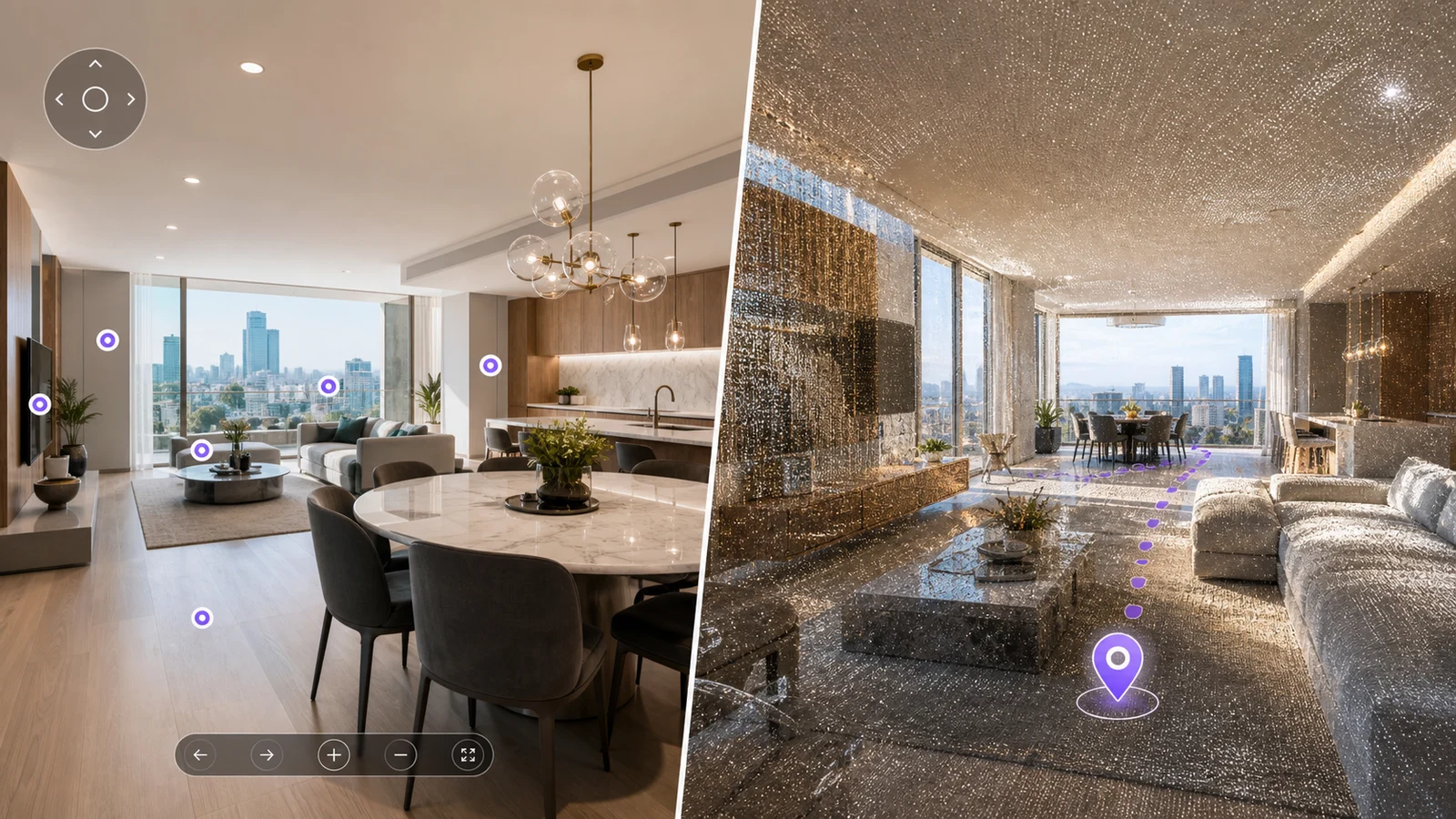
Gaussian splatting vs 360 virtual tours
Use this comparison when deciding what should power a real estate walkthrough, museum experience, heritage preview, or product showroom.
| Decision factor | 360 virtual tour | Gaussian splatting virtual tour |
|---|---|---|
| Realism | Very realistic from each panorama point, but movement between points is guided. | Can feel more spatial because the viewer sees depth, parallax, and free-view movement. |
| Navigation | Best for clear paths, floor plans, hotspots, room labels, and business CTAs. | Best for exploratory movement when a premium sense of presence matters. |
| Capture | Usually captured with a 360 camera, DSLR panorama workflow, or scan platform. | Usually needs many overlapping images or video frames and careful scene coverage. |
| Editing | Easier to retouch, blur private details, replace scenes, and update hotspots. | Harder to patch if objects move, lighting changes, or parts of the scene are missing. |
| Mobile performance | More predictable for web embeds when images are optimized. | Can be heavier; the viewer and asset pipeline need careful optimization. |
| SEO and conversion | Works well inside crawlable pages with copy, FAQs, links, CTAs, and schema. | Needs the same SEO page support; the 3D scene alone does not replace content strategy. |
| Best use cases | Listings, venues, hotels, campuses, museums, tourism, lead capture, and guided tours. | Premium interiors, heritage sites, showpiece rooms, showrooms, and immersive demos. |
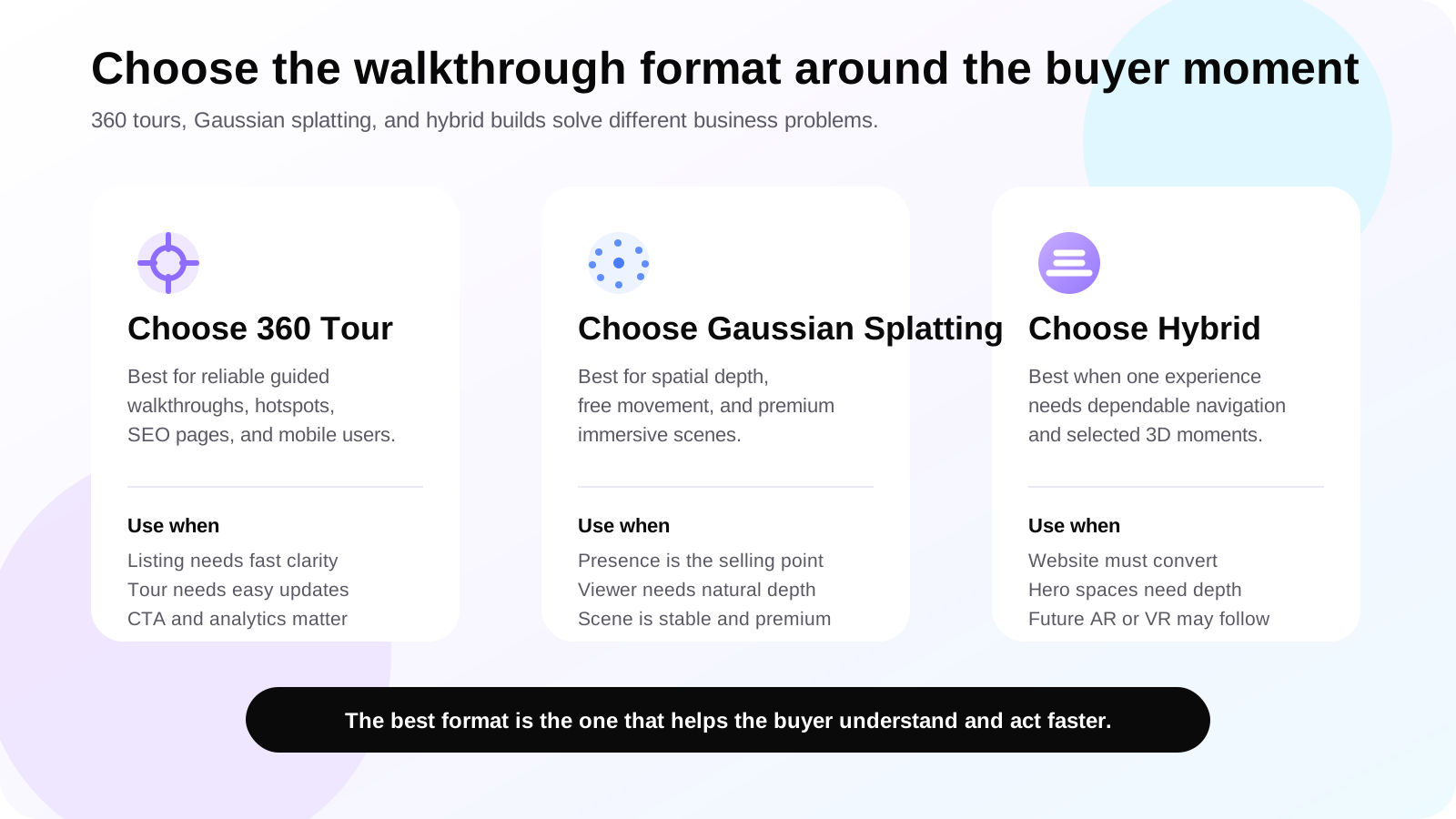
When to choose a 360 virtual tour
Choose a 360 tour when the project needs clarity, reliability, and a conversion-ready web experience.
Real estate listings and rentals
Buyers and renters need to understand rooms, finishes, floor flow, views, and whether the property is worth a viewing.
Hotels, venues, and campuses
Guests, event planners, parents, and stakeholders benefit from guided navigation, labels, maps, and booking or enquiry CTAs.
Museums and public access
A 360 tour can be easier to publish broadly, annotate with exhibit labels, and share with schools or remote visitors.
Lead generation websites
360 tours fit well with SEO pages, forms, analytics, booking links, and sales follow-up because the journey is easier to structure.
When to choose Gaussian splatting
Choose Gaussian splatting when the spatial feeling of the captured scene is the main value.
Premium properties
High-end homes, lobbies, galleries, and showpiece rooms can benefit when the viewer should feel depth, light, and continuous movement.
Museums and heritage spaces
Splat-based scenes can make architecture, sculpture, and historical environments feel more present than a set of fixed panoramas.
Product and showroom moments
A spatial showroom can make a product environment feel more immersive, especially when paired with WebGL, hotspots, or AR planning.
Campaign hero experiences
If the goal is a memorable interactive demo rather than only practical room inspection, a Gaussian splat can become the hero asset.
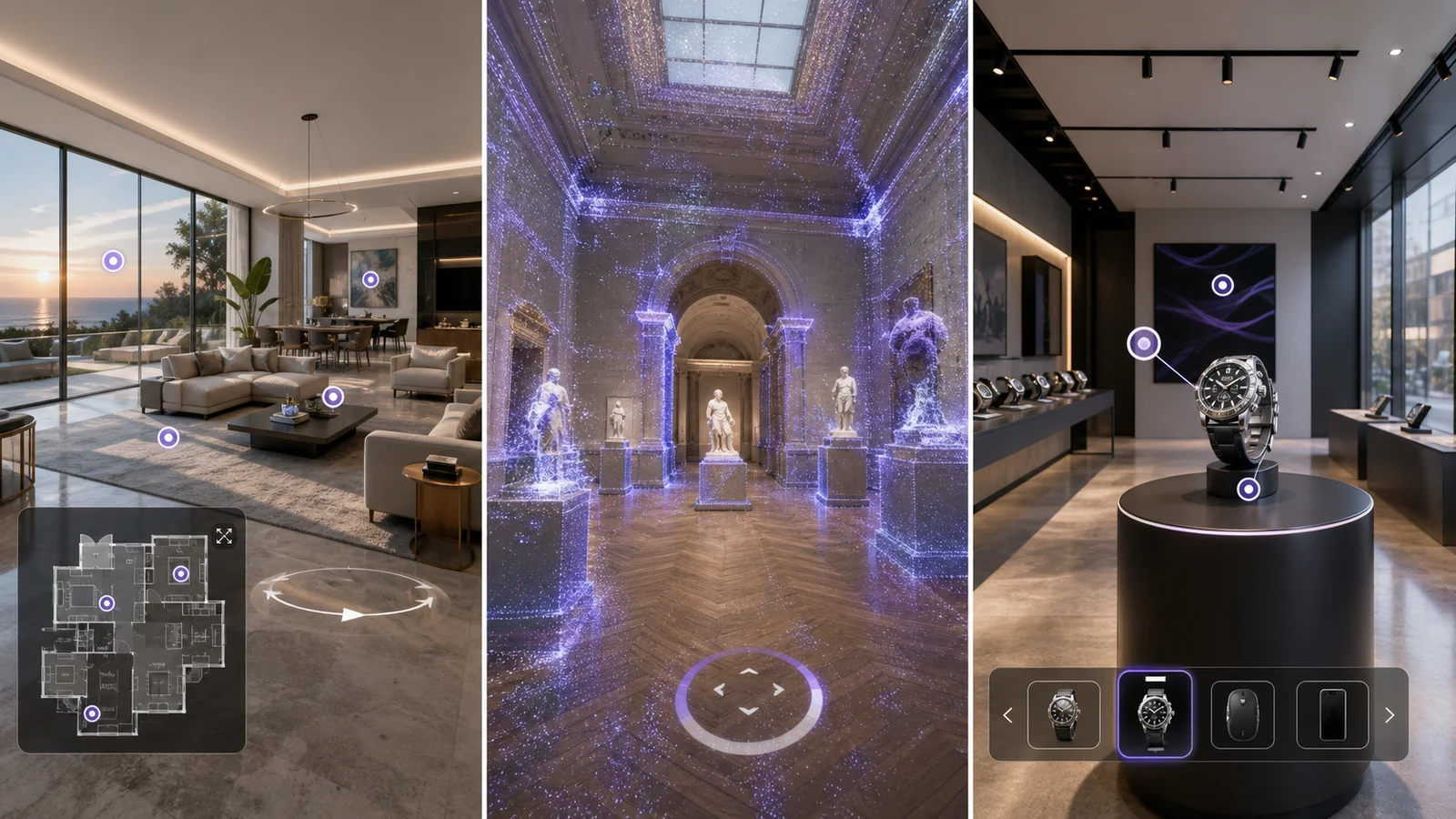
Best format by industry
The right answer changes by audience. A property buyer, museum visitor, and product buyer need different proof.
| Industry | Best default | When to add Gaussian splatting |
|---|---|---|
| Real estate | 360 tour for listings, floor flow, room details, CTAs, and mobile-friendly enquiries. | Add splats for premium interiors, exterior grounds, lobbies, and hero spaces where depth sells the property. |
| Museums and heritage | 360 tour for accessible remote viewing, exhibit labels, school content, and simple sharing. | Add splats for architectural presence, sculpture spaces, heritage interiors, and immersive donor or visitor previews. |
| Product showrooms | 360 tour or product hotspot experience for guided browsing and enquiry flow. | Add splats for premium showroom environments, launch campaigns, spatial demos, or WebGL/AR expansion. |
| Tourism and venues | 360 tour for route planning, amenities, rooms, viewpoints, packages, and booking CTAs. | Add splats for iconic areas, arrival moments, historical rooms, and high-emotion visual storytelling. |
Risks and limits buyers should understand
Gaussian splatting is powerful, but it is not a magic replacement for a planned virtual tour.
- Blurry details can appear when capture coverage is weak, surfaces are reflective, or the scene has thin geometry.
- Large scenes can become heavy, so web delivery and mobile performance need careful testing.
- Changing furniture, signs, products, or lighting later can be harder than updating a normal panorama scene.
- Private information, faces, documents, screens, and license plates still need privacy review before publishing.
- Measurement and floor-plan decisions should not rely on a splat unless the workflow is specifically validated for that purpose.
- A splat viewer still needs a business page around it: title, copy, headings, CTAs, internal links, schema, and analytics.
- These risks are manageable when the project starts with one test scene instead of a full-property build.
Use 360 tours for structure and Gaussian splats for selected moments.
A hybrid walkthrough can keep the dependable tour path, floor plan, hotspots, and conversion flow while using Gaussian splatting for the most impressive or spatially important scenes.
What a hybrid walkthrough can include
A hybrid walkthrough starts with a reliable business structure: a crawlable landing page, clear introduction, guided tour path, floor plan or map, hotspots, captions, and a visible next step. That layer helps the experience work for SEO, sales, and mobile users.
Then selected spaces can use Gaussian splatting where the extra spatial feeling is worth the production effort. For real estate, that may be the living room, lobby, terrace, exterior approach, or a premium amenity. For a museum, it may be a hero gallery or heritage room. For a showroom, it may be the central product display.
This keeps the project practical. The website still converts, the visitor still has guidance, and the premium 3D moments are used where they actually help the buyer understand the space.
How Xentoro can help
Xentoro can plan the experience before the capture method is locked.
Format strategy
Decide whether the project should use a 360 tour, Gaussian splat, WebGL scene, AR preview, VR experience, or hybrid approach.
Capture and asset planning
Define the scene list, viewer journey, capture coverage, privacy checks, content needs, and mobile performance expectations.
Tour UX and conversion
Design hotspots, maps, labels, lead forms, booking links, product panels, analytics events, and calls to action around the buyer journey.
Future AR and VR expansion
Plan how a walkthrough can later support WebGL demos, AR product previews, VR training, sales tools, or multilingual versions.
Final recommendation
If your audience mainly needs to inspect a place, compare rooms, understand layout, and contact your team, start with a 360 virtual tour. It is mature, easier to publish, easier to update, and easier to connect to SEO and conversion goals.
If your audience needs to feel the space, understand depth, and explore a premium scene with more natural movement, test Gaussian splatting on a selected area first. Do not start by converting everything. Start with one high-value scene and review quality, performance, and business impact.
If both are true, choose a hybrid walkthrough. That gives your project the reliability of a 360 tour and the visual lift of Gaussian splatting where it matters.
FAQs about gaussian splatting virtual tours
What are Gaussian splatting virtual tours?
Gaussian splatting virtual tours use 3D Gaussian splatting to reconstruct a captured space from many photos or video frames. Viewers can experience more spatial depth and free movement than a standard fixed-point 360 tour, depending on capture quality and viewer performance.
Is Gaussian splatting better than a 360 virtual tour?
Not always. Gaussian splatting can feel more spatial and immersive, but 360 tours are often more reliable for guided navigation, hotspots, mobile delivery, SEO pages, updates, and lead generation. The better format depends on the project goal.
Is Gaussian splatting good for real estate?
Gaussian splatting can be useful for premium real estate scenes where depth, atmosphere, and free movement help sell the property. For everyday listings, a polished 360 tour is often the more practical first choice.
Can museums use Gaussian splatting?
Yes. Museums and heritage sites can use Gaussian splatting for immersive galleries, architectural spaces, and selected exhibit areas. A 360 tour may still be better for broad access, labels, school content, and simple sharing.
Can a website combine 360 tours and Gaussian splats?
Yes. A hybrid walkthrough can use 360 tours for structure, floor plans, hotspots, CTAs, and SEO support, then add Gaussian splat scenes for high-impact rooms, heritage spaces, or premium product environments.
Plan the right 3D walkthrough.
Xentoro can help compare 360 tours, Gaussian splatting, WebGL, AR, VR, and hybrid options around your buyer journey, budget, content, and launch plan.